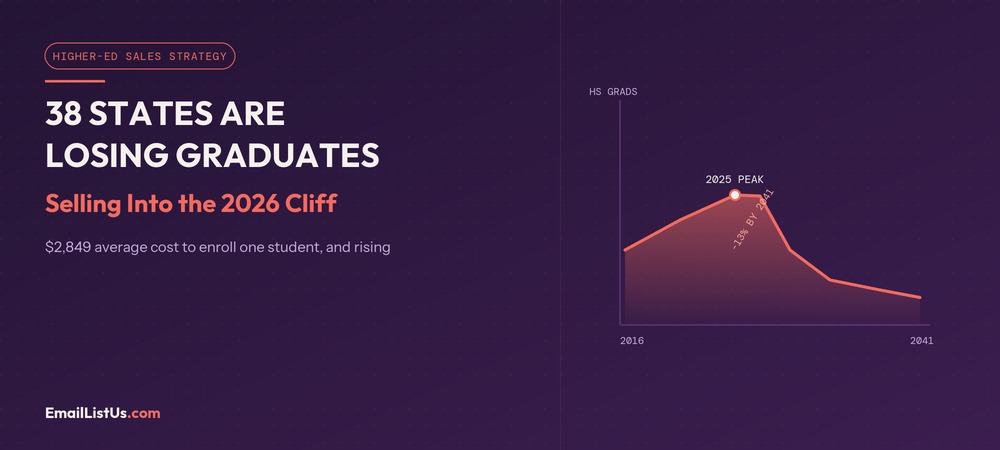
High school graduates peaked at roughly 3.8 to 3.9 million in 2025. From here, WICHE projects the count falls in 38 states through 2041, taking the national total down about 13% from this year’s peak. Fall 2026 is the first semester that decline actually lands on a campus, and it changes who colleges need to reach and how much they’re willing to spend to reach them. Vendors selling to higher ed should read this as a buying signal, not just bad news for admissions offices.
For your numbers: the average university already spends roughly $800,970 a year on digital recruitment ads, about 3.6% of revenue, at a cost of about $2,849 per enrolled student. That number rises every year enrollment falls, and it is the budget line your pitch is competing for.
The Decline Isn’t Even, So Don’t Sell Like It Is
WICHE’s regional breakdown matters more than the national average. The Northeast loses 17% of its high school graduates by 2041, the Midwest 16%, the West 20%. The South is the only region expected to grow, up 3% through 2037, and 12 states plus Washington, D.C. see increases, some by double digits: South Carolina, Tennessee, Idaho, North Dakota. A vendor pitching “the enrollment cliff” the same way to a college in Ohio and one in South Carolina is pitching the wrong problem to half of them. Segment your target list by region before you segment it by institution type.
The Stakes Are Already Showing Up as Closures
Sixteen nonprofit colleges closed in 2025, and at least eight more announced closure in 2026 as of midyear. Every one shared the same profile: small, private, tuition-dependent, with enrollment declines of 30% to 70% over the prior decade, concentrated in the rural Northeast and Midwest. That is the sharp end of the same demographic trend driving the budget conversation everywhere else. A college that isn’t closing is still making the decisions that keep it from becoming one, and that urgency is what makes this a live selling moment instead of a slow-moving trend.
Where Colleges Are Actually Putting New Money
Institutions aren’t just raising ad spend against a shrinking pool of 18-year-olds. They’re diversifying who counts as a prospect: transfer students from community colleges, the 39 million U.S. adults with some college credit but no degree, and K-12 dual-enrollment partnerships that build a pipeline years before senior year. The college-going rate itself has fallen from 70% in 2016 to 62% in 2022, and WICHE’s own modeling found that a 0.5-point increase in that rate would offset the entire projected graduate decline through 2041. That is the real opportunity: products and services that help a college convert, retain, or reach a nontraditional prospect are solving the problem colleges actually have budget to fix.
That shift also changes what a recruitment message needs to do. A prospect who is 28 and already has some college credit responds to a different pitch than a high school senior, and campaigns built for one audience read as generic to the other. The same discipline that makes a K-12 marketing email convert, a specific hook, a named persona, one clear ask, applies to a transfer-student or adult-learner campaign just as directly, and most higher-ed vendors are still sending the same generic message to every prospect type at once.
Who Signs Off on the Budget You’re Chasing
The vice president of enrollment management, sometimes titled chief enrollment officer, now owns recruitment marketing, admissions, financial aid strategy, and enrollment analytics as one connected budget, not four separate ones. That consolidation happened specifically because institutions need every recruitment dollar working toward the same yield number. Pitching a marketing point solution to an admissions director who doesn’t control the ad budget wastes a cycle; the VP of enrollment management is who actually signs.
Title-verified college and university contact data is what makes that reach possible in practice, since enrollment leadership titles vary by institution size and turn over on the same cycle as the students they’re trying to recruit. A list that was accurate at the start of the last admissions cycle is a poor guide to who holds the budget now.
Sell to the Institutions Fighting for Every Student
The enrollment cliff isn’t a reason to write off higher ed as a shrinking market. It’s a reason colleges are spending more per prospect, diversifying who they recruit, and consolidating budget under people with the authority to buy fast. Target the regions still growing and the institutions diversifying hardest, not the national average, and reach the enrollment management office directly rather than working around it. The university mail gateways that decide whether your outreach lands are stricter than any K-12 filter, so the list you start with matters as much as the pitch.