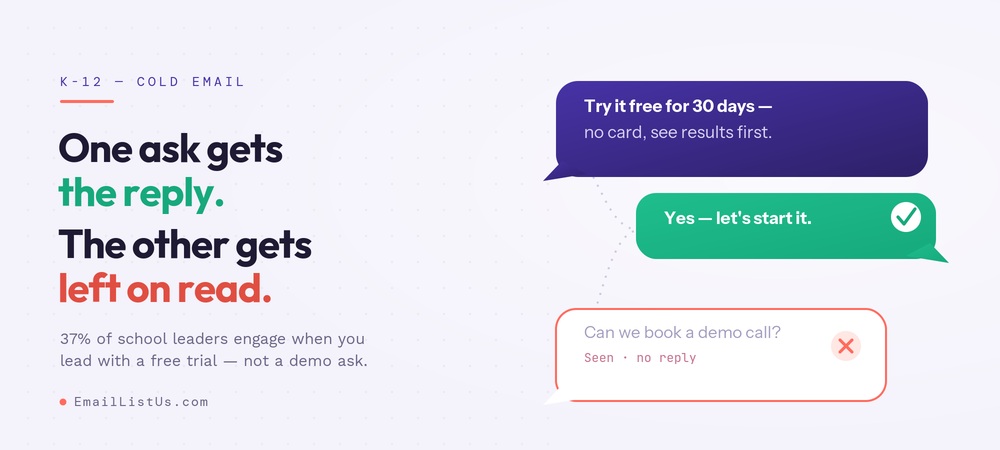
Nearly four in ten K-12 officials — 37% — say they’re more likely to engage with a vendor that offers a free trial, according to the EdWeek Research Center. Yet most cold emails to schools open with a feature list and a request for a 30-minute demo. That mismatch is the real reason your reply rate is low, and it’s one of the most fixable problems in education sales.
If you want to know how to get K-12 schools to respond to cold email, start by changing the ask — not the subject line.
Why K-12 cold email gets ignored
School administrators are pitched constantly, they’re chronically short on time, and they’re spending public money under scrutiny. A cold email that asks for a 30-minute demo asks them to hand their scarcest resource — time — to an unproven vendor before they’ve seen anything work. The rational response is to ignore it.
So the problem usually isn’t your product or even your copy. It’s that the very first thing you ask for is too expensive for a stranger to grant. Lower that cost and the math changes.
The one thing that changes the answer
Remove the risk. A free trial, pilot, or no-commitment proof-of-concept flips your ask from “give me your time” to “try it yourself, free.” That’s a fundamentally easier yes — and the data backs it. Beyond the 37% who say a trial makes them more likely to engage, free trials rank among the top ways K-12 officials discover and evaluate new products in the first place (EdWeek Research Center). You’re not interrupting their buying process; you’re handing them the exact thing they already use to evaluate vendors.
Why it works: it matches how schools actually buy
Public money plus accountability means school buyers need proof before they commit — proof they can defend to a business manager, a principal, or a board. A trial lets them generate that proof internally, on their own timeline, with no procurement risk. You stop asking them to trust your claim and start letting the product make the claim for you. That’s why a low-risk offer consistently out-pulls a polished pitch.
How to put it in a cold email
The offer only works if the email is built around it. Four steps:
1. Lead with the offer, not the features. Your first line should name a specific problem and the free trial — not your company history. “You can try [product] free for 30 days and see [specific result] before you decide” earns more replies than three paragraphs about your platform.
2. Make the trial genuinely low-friction. No credit card, no lengthy setup, a clear start and end date. Every extra step you require shrinks the number of administrators willing to say yes. The easier the trial is to start, the more the offer does its job.
3. Aim at the right role. A free trial is only persuasive to the person who’d actually use or approve it. Because most K-12 purchases involve several people, multi-thread across the buying committee rather than betting on one inbox, and tailor the offer to each role. See cold email templates for principals for role-specific framing.
4. Keep it short and credible. A free-trial email should be a few tight sentences with one clear next step. Model the structure on the anatomy of a high-performing K-12 email, and back the offer with one quick proof point — a peer district, a number, a name they’ll recognize.
Make the easy yes
Getting K-12 schools to respond to cold email isn’t about a cleverer subject line or a longer pitch. It’s about lowering the cost of the first yes. Lead with a genuinely low-risk way to try what you sell, aim it at the right role, and keep the message short and credible. Do that and you’re working with how school buyers already evaluate vendors — instead of against it.