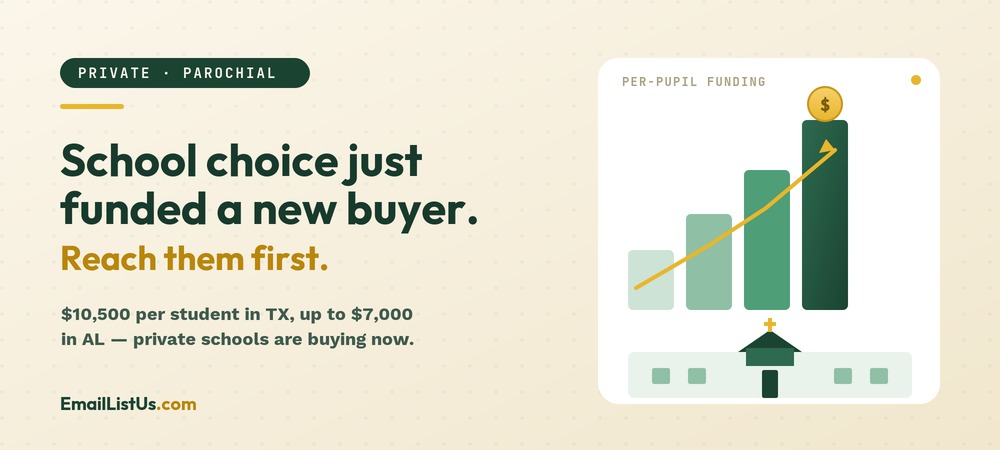
Texas just launched a $1 billion education savings account program — the largest first-year school-choice fund in U.S. history — enrolling roughly 96,000 students at $10,500 each for private and hybrid schooling. Alabama’s CHOOSE Act put $250 million behind up to $7,000 per student for about 50,000 applicants. Oklahoma raised its parental-choice tax credit cap to $275 million. If you sell into education and your list stops at public districts, you’re ignoring a segment that went from shoestring budgets to real purchasing power in a single year. Knowing how to sell to private schools flush with ESA funding is the clearest new-revenue opening in K-12 for 2026.
Why this changes your addressable market
Private and parochial schools were historically hard to sell to for one reason: they didn’t have money. That constraint is dissolving. Education savings accounts and tax-credit scholarships now route thousands of dollars per student directly to families who spend it at private schools, which turns tuition-dependent institutions into buyers with discretionary budgets. And it isn’t a one-year blip. Congress passed a federal tax-credit scholarship through the 2025 One Big Beautiful Bill Act, letting individuals contribute up to $1,700 to scholarship-granting organizations starting January 1, 2027, with roughly 30 states already opting in. The funding trend points up and to the right for at least the next several years.
The buyer is not who you think
A private or parochial school doesn’t have a superintendent, a curriculum director, or a central-office procurement team. The decision-maker is usually the head of school, the principal, or in Catholic systems, a diocesan or superintendent-of-schools office that oversees dozens of campuses at once. That last point matters: reaching one diocesan office can open a door to many buildings.
This is a different contact set than public-district data, which is exactly why so many vendors miss it. If your outreach is built on public-school titles, you won’t find the private school principals and heads of school who actually approve purchases at these newly funded schools. The same gap applies to the fast-growing charter segment, where a charter school leader or management-organization office may control buying across a whole network.
What newly funded private schools are buying
New per-pupil dollars flow toward the things these schools couldn’t previously afford. That means curriculum and instructional materials, student-information and enrollment software, facilities and furniture as they add seats, security systems, tutoring and special-education services, and back-office tools to handle the sudden enrollment growth. If you sell any of it, the pitch writes itself: these schools are enrolling more students, collecting more per-student funding, and building out capacity on a compressed timeline.
How to pitch a first-time buyer
Selling to a school that has never had a real budget requires a different motion than selling to a district that buys every year.
1. Name the funding source in the first line. “Your state’s ESA program is bringing new per-pupil dollars this year” signals you understand their moment better than a generic product pitch ever will.
2. Sell to enrollment growth, not just the product. Tie your solution to the operational strain of taking on more students — that’s the pain they’re feeling right now.
3. Keep the buying process light. These schools don’t run RFPs or board votes for most purchases. A head of school can often say yes in one conversation, so your outreach should aim straight at that person.
4. Respect the mission. Parochial and faith-based schools weigh fit and values, not just features. Lead with how you support their students and community, and the cold-email approach that works with school leaders — short, specific, and respectful of their time — travels well here.
Move before the segment gets crowded
The public-district market is saturated with vendors fighting over the same superintendents. The ESA-funded private and parochial segment is not — yet. Right now these schools are flush, under-solicited, and making first-time buying decisions that tend to stick for years. The vendors who build the right list and reach the head of school this cycle will be the incumbents when everyone else notices the money moved. Start with accurate contact data for the private and parochial schools now holding real per-pupil budgets.