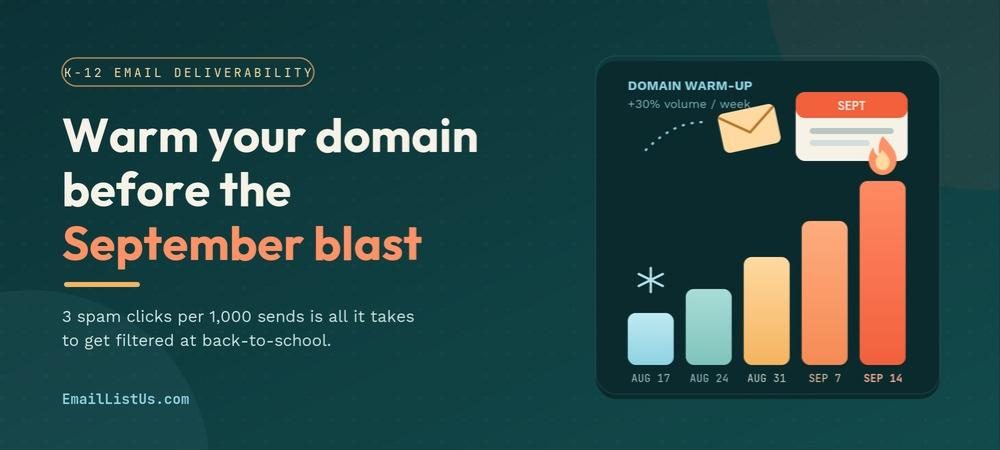
Since late 2025, Gmail rejects non-compliant bulk email outright instead of quietly filing it under spam, and Microsoft has been bouncing unauthenticated volume senders with a hard 550 error since May 2025. If your school list sat untouched since the last bell rang in June, email deliverability to schools this September depends almost entirely on what you do in the next three weeks.
Here’s the trap: mailbox providers treat extended inactivity as reputation decay. A domain that went quiet in June gets scored in September like a near-new domain. Fire your full back-to-school blast at 40,000 educators on day one and Gmail, Microsoft, and the district filters behind them read that sudden spike from a silent sender as a textbook spam pattern.
The math that gets vendors blocked
Google’s spam-complaint threshold is 0.3%, which is 3 complaints per 1,000 delivered emails. On a 20,000-contact district send, 60 annoyed recipients clicking “report spam” is enough to degrade your domain for weeks, and Google’s own guidance warns that recovery after crossing 0.3% is slow. The safe operating level is under 0.1%. Bounces compound the problem: a list that decayed over the summer can throw double-digit hard-bounce rates on its first send, and mailbox providers read a bounce spike from a quiet domain the same way they read complaints, as evidence the sender bought or neglected the list.
September stacks the odds against you. Principals and district administrators return to inboxes buried in vendor mail, so tolerance is low and the spam button is close. Your domain, meanwhile, has spent 10 weeks generating zero positive engagement signals. Cold reputation plus peak-season complaint risk is how a vendor with a perfectly good product spends October emailing nobody.
Three gates your September send has to pass
Gmail and Yahoo require SPF, DKIM, and DMARC authentication, RFC 8058 one-click unsubscribe, and a spam rate held below 0.3% for anyone sending 5,000+ emails a day. Since November 2025, mail that fails these checks is rejected, not junked.
Microsoft applies the same authentication bar to senders of 5,000+ daily messages into Outlook, Hotmail, and Live. Non-compliant mail bounces with error 550 5.7.15. This matters more than most vendors realize, because a large share of U.S. districts run staff email on Microsoft 365, and consumer-grade reputation signals feed the same filtering stack.
District filters sit behind both. School IT departments layer their own gateways on top of Google and Microsoft, and they punish exactly what a cold blast produces: high bounce rates from summer staff turnover and sudden unfamiliar volume. The contact decay is real; principal turnover has run in the mid-teens nationally, and every departed principal is a dead address still sitting on your spring list. That’s one reason a verified public school principals list outperforms whatever your CRM exported in May.
The three-week warm-up calendar
Deliverability specialists put a full re-warm at three to six weeks. Counting back from a post-Labor Day launch, the ramp starts now.
1. This week: fix authentication and clean the list. Verify SPF, DKIM, and DMARC pass on your actual sending domain, confirm one-click unsubscribe is live, and purge every bounce and role change from last school year. Verified district-level contact data beats re-sending to a list that decayed all summer.
2. Week of August 24: send small and warm. Start with your most-engaged segment, the past openers, repliers, and customers, at a few hundred sends a day. Early opens and replies are the trust signals Gmail and Microsoft use to rebuild your score.
3. Week of August 31: ramp roughly 30% at a time. Widen to less-engaged segments gradually. Never jump volume more than about 30% week over week, and hold steady if bounces or complaints tick up.
4. Week of September 7: launch at full volume, watching the dials. Track Google Postmaster Tools daily. Spam rate approaching 0.1% means slow down, not push through.
Content still decides the complaint rate
A warmed domain earns you the inbox; the message keeps you there. Sends that open with the recipient’s actual problem, budget timing, staffing, back-to-school logistics, draw replies instead of spam reports, and replies are the strongest positive signal a mailbox provider sees. Keep the one-click unsubscribe prominent too; an easy exit turns a would-be spam complaint into a harmless list removal that costs you nothing. The structural rules in the anatomy of a perfect K-12 marketing email are worth a re-read before the first warm send goes out.
Your September open rate is decided in August
Education audiences reward senders who reach the inbox; the sector posts some of the highest open rates of any industry, north of 30% in multiple 2025 benchmarks. The vendors who capture that in September are the ones warming their domain and verifying their list in August. Start the ramp this week, hold the 30% ceiling, and your back-to-school campaign lands in front of educators instead of a filter.