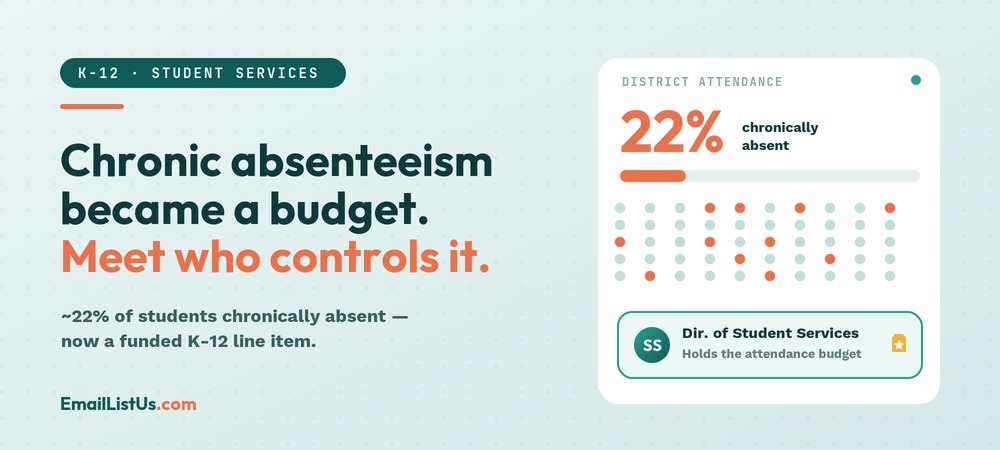
About 22% of K-12 students were chronically absent in the 2024-25 school year — roughly 10.8 million kids — and in nearly half of large urban districts the rate topped 30%, according to RAND’s American School District Panel. That number stopped being a compliance footnote years ago. Districts now fund attendance recovery as a standing line item, and the person controlling that spend is usually a student-services or attendance director that most vendor lists don’t even carry. If you sell to schools and you’re reaching K-12 student services directors by accident instead of on purpose, you’re leaving a funded, low-competition buyer on the table.
Why this hits your pipeline, not just their spreadsheet
In Texas and California — the two largest states still funding schools on average daily attendance — every chronically absent student is a direct revenue loss to the district. That turns absenteeism into a budget problem the CFO tracks, not a soft goal a counselor mentions. Real money is moving toward solutions: SEL platforms, high-dosage tutoring, mental-health services, family-engagement apps, ride-share and transportation, and early-warning data systems. Eighteen states have formally adopted a goal to cut their 2022 absenteeism rate in half by 2027, which puts these directors on a public clock with board-visible numbers. A buyer under a deadline with a budget is the easiest sale in K-12 — if you can find them.
Who actually owns the attendance budget
The title changes from district to district, which is exactly why generic lists miss it. Look for Director of Student Services, Director of Student Support, Director of Whole Child, Attendance & Engagement Coordinator, or a Dean of Students at the building level. In smaller systems, an assistant superintendent carries the role alongside three others.
What they share: this person sits between academics and operations, influences or directly controls the intervention spend, and reports absenteeism figures up to the superintendent and board. They are the economic buyer for anything that moves the attendance needle — and they’re frequently a different human than the curriculum or IT contact you already have.
Why your current school list skips them
Most vendor databases were built around superintendents, principals, and IT or curriculum directors. Student services is a cross-functional role that got funded and staffed up after 2021, so it’s underrepresented in older data. The result is predictable: your pitch lands with a principal who forwards nothing, or bounces off a title that was reorganized last summer. Clean, district-level contact data that carries the student-services title is the difference between a pitch that reaches the buyer and one that dies in a shared inbox.
A four-step play for the absenteeism buyer
1. Lead with their metric, not your feature. Open with the district’s own chronic-absenteeism rate or ADA exposure, not your product name. “Your 2024-25 rate sat near 28%” earns a read; “Introducing our platform” does not.
2. Translate it into dollars at risk. Frame the pitch in their language: recovering two points of average daily attendance is worth a specific, sourceable amount in states that fund on attendance. That’s a number a director can carry into a budget meeting.
3. Bring a peer district. Districts buy what comparable districts bought. A one-line result from a similar-sized system does more than a feature list. This is also where engaging K-12 district buyers as a group — not a single contact — starts to matter.
4. Time it to the planning calendar. Intervention plans for the coming year get set in summer, so that’s when the director is deciding where the money goes. The case for hitting them early is the same one behind selling in the summer window before the new school year.
Plan for more than one signature
Student-services directors rarely buy alone. The CFO signs off on anything tied to funding, principals weigh in on anything that touches their buildings, and larger purchases still route to the board. Build your outreach to reach the director first, then arm them with the ROI language and peer proof they need to sell it internally. Knowing the strategies that reach district decision-makers across that committee keeps a promising lead from stalling at the one contact you happened to have.
Get on the list before the plan is locked
The directors funding attendance work are choosing their vendors for the coming year right now, while absenteeism is still a headline and the budget is still open. The vendors who win aren’t the ones with the loudest product — they’re the ones who reached the right title, in their language, before the intervention plan was set. Start by getting accurate contact data for the people who actually hold that budget.