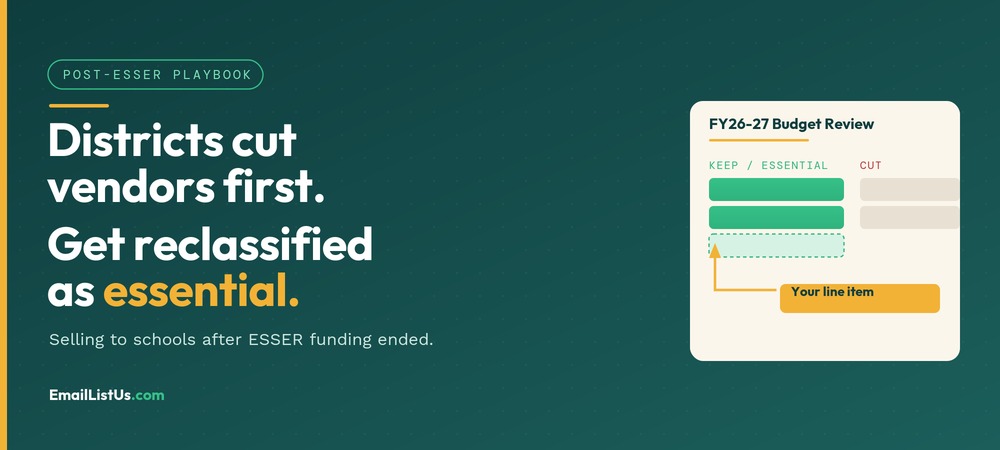
The federal stimulus is gone. The March 28, 2026 deadline to liquidate ESSER dollars passed with no further extensions, leaving as much as $3 billion in already-obligated contracts stranded across 41 states, and the 2026-27 fiscal year that began July 1 is the first fully stimulus-free budget K-12 has run since the pandemic. Selling to schools after ESSER funding ended means walking into a room where the first instinct is to cut outside vendors, not your price. When districts trim, they protect payroll and programs and drop external services first, so the question deciding your renewal isn’t whether you’re affordable. It’s whether the buyer can defend your line item as essential.
That distinction is now worth real money to your pipeline. A pitch that reads as “nice to have” gets tabled in finance review you never see; a pitch tied to a funded mandate or a cost the district already has to cover survives the cut. Repositioning isn’t a discount play. It’s about which budget line your product lives on.
Why vendors are first on the chopping block
When a budget contracts, a district board’s job is to protect classrooms and the people in them. Tutoring contracts, supplemental software, professional development, and outside services are the easiest things to cut because nobody loses a job and no school closes. Superintendents are increasingly reporting economic pressure on their districts, and that pressure flows straight to discretionary spend, exactly where most vendors sit.
The mistake is reading a stalled deal as a pricing objection. It usually isn’t. The product tested well and the champion wants it; the purchase still dies because no one could answer “is this essential?” when the business office asked. Solve that question before it’s asked and you stop losing winnable deals in the silent part of the process.
The “essential” test every purchase now faces
Every purchase in a tight year runs an informal screen: Does this protect a core obligation, satisfy a mandate, or replace a cost we’re already paying? If your product can be tied to a compliance requirement, a safety duty, a state-mandated outcome, or a line the district must fund regardless, it clears the screen. If it reads as an enhancement, it waits for a better year.
This is also a buying-process problem. Knowing why some purchases require board approval and others don’t tells you how to structure a first deal that survives scrutiny, and understanding the full K-12 buying process from teacher request to board approval shows you where the “essential” judgment actually gets made.
How to reposition your pitch as essential
You don’t change the product. You change the budget line it attaches to.
1. Map your product to a funding stream that survived. ESSER is gone, but Title I, IDEA special-education dollars, Title IV, and state grants remain. Name the specific source that can pay for you in the pitch itself. A buyer who hears “this is Title I-eligible” hears “this won’t cost me general-fund money.”
2. Frame around a cost the district already carries. If your product reduces a vacancy cost, a compliance risk, a substitute-teacher bill, or a paper-and-print line, you’re not new spending, you’re a swap. Swaps survive cuts that add-ons don’t.
3. Tie it to a mandate or a protected priority. Anything connected to safety, accessibility, assessment requirements, or IDEA-protected services is far harder to label optional. Lead with the obligation, then the product.
4. Bring proof, not adjectives. A district paying for outcomes wants a number: hours saved, a measured result, a cost avoided. Quantify the return the way the business office will have to when it defends the spend upstream.
Reach the person who decides if you survive the cut
The reframe only works if it reaches the right desk. After ESSER, the district business official or CFO has more veto power over vendor spend than the program team that loves your product, and most vendors never email that person. Closing in this climate means reaching the school and district decision-makers who control survivable budgets, not just the champion who requested you.
That requires accurate, title-level contact data: the business official, the federal-programs director, the special-education director, the people who decide what counts as essential. Build outreach around verified district decision-maker contacts and your “essential” message lands where the cut decisions are actually made.
The vendors who keep closing in the first post-ESSER year aren’t the cheapest. They’re the ones who made it easy for a budget owner to call them essential, and who got that message in front of the right person at the right title. Reposition your pitch around survivable money, prove the return, and reach the buyer who signs off, before the next round of cuts decides for you.