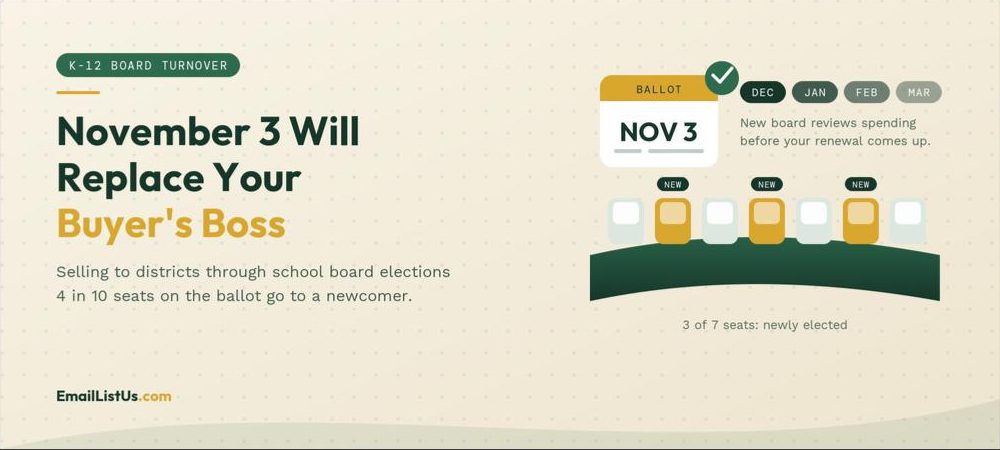
Roughly four in ten school board seats on the ballot this November will go to someone who is not sitting in them today. In the 187 large districts Ballotpedia tracked in 2025, 31% of seats had no incumbent running at all and non-incumbents won 42% of all seats up for election; across 6,060 seats from 2018 to 2024, newcomers took between 39% and 49% every year. For anyone selling to districts, school board elections on November 3 are not a civics footnote. They decide who your superintendent answers to for the next four years, and by extension which contracts get renewed, questioned, or pulled.
Why board turnover hits your pipeline harder than it used to
Boards used to sit at the edge of purchasing. That has changed. One-third of district and school administrators told EdWeek Market Brief in 2025 that they expect their board’s influence over buying products and services to grow, and boards are inserting themselves most often into curriculum decisions. Meanwhile superintendent turnover ran at 23% across the 500 largest districts in 2024-25, a record, and superintendents consistently name board relations among the top five things consuming their time (41% in AASA’s 2025 study). Board relations are one of the most-cited reasons superintendents leave, and a superintendent leaving is the fastest way a vendor’s champion disappears.
Illustrative math: if a fifth of your accounts elect a new majority and a quarter of those replace the superintendent within a year, about 5% of your book changes decision-makers by summer 2027, on top of the churn already running.
The 120-day window after November 3
New members are typically sworn in between the first week of December and the first week of January (Fairfax County seated its board December 13; Loudoun County on January 6), and the first organizational meeting sets committee assignments in January. From there the sequence is predictable: budget workshops for the next fiscal year open in January and February, the superintendent’s evaluation and contract review follows in the spring, and multi-year vendor contracts come up for scrutiny in the same cycle. If your renewal or new deal lands between December and March, it will be read by at least one board member who has never seen your name.
Four moves for vendors selling into a district with a new board
1. Segment your account list by election status now. Pull board election dates for every district in your pipeline (Ballotpedia covers the 475 largest; state school board associations publish the rest) and tag each account “no election,” “incumbents safe,” or “open seats.” In 2025, 36% of races were unopposed and 84% of incumbents who ran won, so the risk concentrates in a minority of districts, which is why mapping it pays. Districts that put facilities bonds on the same November ballot deserve a second tag, since a new board inherits that spending too.
2. Re-thread the account below the superintendent before December. A superintendent facing a new majority spends the winter managing up, not managing vendors. The director who owns your budget line and the business official who processes the purchase order survive a leadership change. If your only relationship in the district is the superintendent, you are one election away from starting over, the same exposure covered in selling through the superintendent turnover wave. Two named contacts below cabinet level, confirmed by email before Thanksgiving, is the minimum.
3. Write the board-ready one-pager your champion can forward. New board members are not procurement or pedagogy experts, which EdWeek Market Brief flags as the reason boards scrutinize curriculum, devices, and student-data products first. Give your director a single page: what the district bought, what it cost per student, the measurable result to date, and the contract end date. Send it in early December so it is in the file before the January budget workshop, not after a board member asks “what is this line item.”
4. Prospect the losing side’s neighbors. Board turnover creates buyers as well as risk. A new majority that campaigned on reading scores, safety, or fiscal discipline will fund something that proves the point in its first budget. Districts whose new members ran on a specific issue are the warmest cold prospects of the year, and the requests for information start in the superintendent’s office. Verified superintendent contacts, refreshed after the January reorganizations, are the entry point.
What to send in December, January, and February
December: a two-sentence congratulations to the district (not the board member) through your director contact, with the one-pager attached. January: a short note to the business official confirming the contract term and asking whether the new budget calendar changes anything. February: the first outreach to net-new districts where the election produced a mandate you can serve, with a subject line that names the issue the campaign was about. None of these emails should go to a newly elected board member directly; in most states, vendor contact with trustees outside the public process is at best frowned on and at worst a procurement violation.
Selling through school board elections without losing the account
Map which accounts have open seats, confirm two contacts below the cabinet before December, put a board-ready summary in your champion’s hands, and use the mandates new boards campaigned on to open districts you do not have yet. School board elections vendor sales strategy comes down to one principle: the account belongs to the people who will still be there in January.