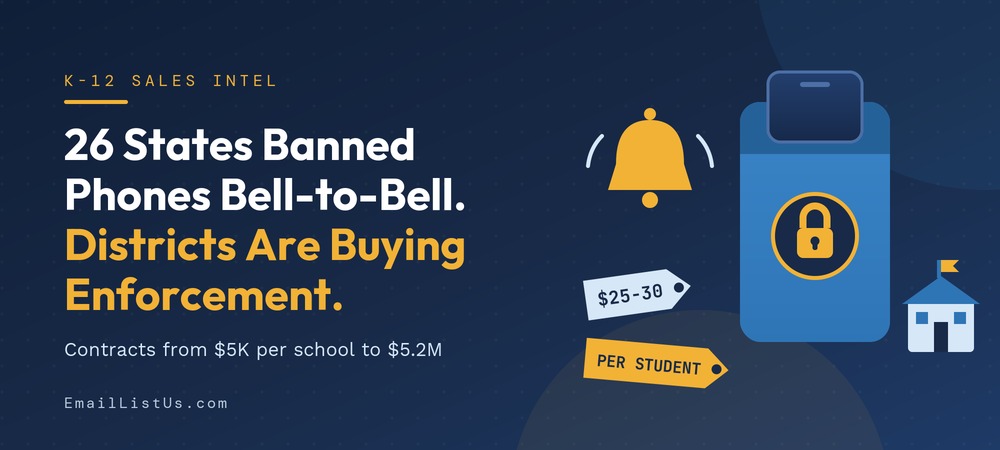
Twenty-six states now require bell-to-bell cell phone bans in public schools, and most of those laws take effect for the 2026-27 school year — the one starting right now. That has created a school cell phone ban compliance budget that barely existed three years ago: districts are buying magnetic pouches, phone lockers, check-in cabinets, signage, and enforcement training, with contracts running from about $5,000 for a single school to $5.2 million at Los Angeles Unified.
If you sell storage products, safety equipment, software, furniture, training, or communications services to K-12, this is a new line item with a legal deadline attached. Deadline-driven purchases compress the sales cycle: the district doesn’t debate whether to buy, only what and from whom. Vendors who reach the right buyer in August and September will close deals this semester; vendors who wait for the fall conference circuit will find the purchase orders already cut.
A Procurement Category That Didn’t Exist Three Years Ago
The spending is documented, not hypothetical. Yondr, the best-known pouch maker, recorded roughly $19 million in K-12 sales in 2025, according to GovSpend contract data, and reports its pouches are used by about three million students. Per-student pricing for locking pouches generally lands in the $25-30 range, which is why the contracts scale with enrollment: Cincinnati Public Schools spent about $500,000 to cover grades 7-12, Houston allocated $800,000, and LAUSD committed $5.2 million.
States are adding fuel. New Jersey’s Phone-Free Schools Grant Program awarded a cumulative $980,000 to 86 districts to buy lockers, locked pouch systems, and check-in cabinets ahead of its bell-to-bell mandate, which begins with the 2026-27 school year. A funded mandate is the best prospect signal in K-12: the district has the obligation and the money in the same fiscal year.
Who Owns the Phone-Ban Budget
Enforcement lives at the building level, so the buying center looks different from a typical district purchase. Principals and assistant principals choose how phones get collected, stored, and returned each day, because their staff run the process at the door. District operations and student services leaders set the standard when the district buys once for every campus. The school board’s role is usually limited to adopting the policy the state now requires.
Purchase size decides the approval path. A $6,000 pouch order for one middle school often sits inside a principal’s discretionary budget and closes in weeks; a district-wide $250,000 storage contract goes through purchasing and possibly the board. Knowing which purchases require board approval and which don’t tells you whether you’re writing one email to a principal or building a case for a committee.
The Compliance Deadline Is Doing Your Prospecting for You
Most 2026-27 bans take effect in August and September, which splits demand into two waves. The first wave is happening now: schools that must be compliant on day one are buying storage and signage before the doors open. The second wave hits midyear, when districts replace damaged pouches, upgrade from cheap bins to managed systems, add detection or monitoring software, and fund parent-communication campaigns after the first semester exposes the gaps in a rushed rollout.
The practical takeaway: a district that improvised with shoe organizers in September is a warm prospect for a durable system in January — especially in states like New Jersey where grant cycles put fresh implementation money on the table.
Write the Email an Enforcement-Weary Principal Will Answer
Skip the screen-time research; administrators have already read it. Lead with the operational pain: staffing the collection point, the first-period arguments, the parent phone calls. Reference the reader’s own state statute and its effective date so the email reads like it was written for their district, not a national blast. One specific line — “Ohio’s bell-to-bell requirement takes effect this fall; here’s how districts your size are handling collection without adding staff” — outperforms a paragraph of product features. If principals are your entry point, these cold email templates for reaching school leaders show the structure that gets replies.
Move Before the Bell Does
A legally mandated, state-funded purchase category with an August deadline is as close to a sure thing as K-12 sales offers, and it will not stay uncrowded past this school year. The single most important action: build a state-by-state outreach list of principals, assistant principals, and district operations leaders in the 26 ban states, and get your compliance-focused email out while budgets are still being spent. Accurate school-level contact data by title is what separates vendors selling into this window from vendors reading about it next spring.