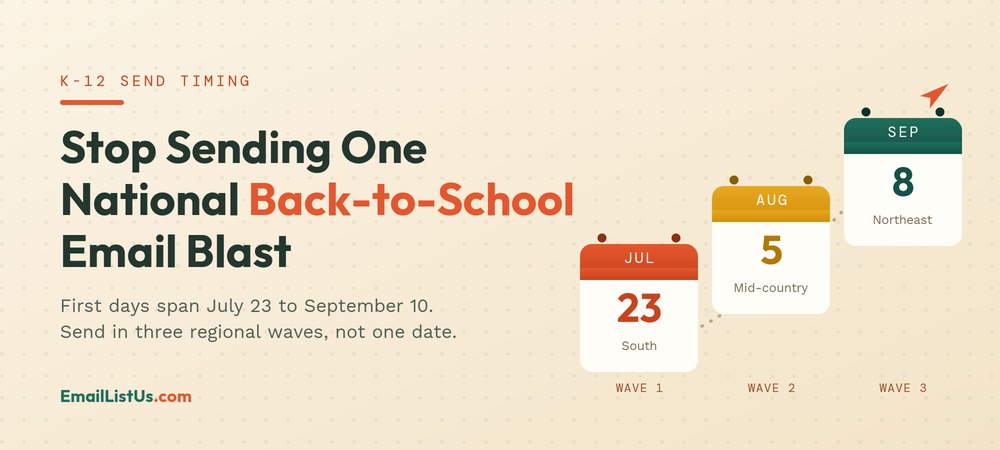
The 2026-27 school year does not have a first day. It has about seven weeks of them. Districts in South Carolina’s Aiken County went back the week of July 23. Chattooga County, Georgia returned July 24, most of metro Atlanta reports August 3, several Mississippi districts start July 29, and New York City doesn’t open until September 10. If your back to school email campaign timing is built around one national send date, you are early for a third of the country, late for another third, and on time mostly by accident.
That mistiming is expensive because back-to-school is the highest-intent window on the vendor calendar. Principals are staffing up, filling supply gaps, and spending what’s left of opening-year budgets. An email that lands during teacher workdays gets read and acted on. The same email arriving mid-vacation in Vermont, or three weeks after the rush in Georgia, competes with a full inbox and an empty discretionary line.
The Calendar Splits Along a Regional Fault Line
The pattern is consistent enough to plan around. Southern states, Georgia, South Carolina, Mississippi, Tennessee, plus much of Arizona and Indiana, open in late July through the first days of August. The mid-country belt, Texas, the Midwest, most of the West, clusters around mid-August. The Northeast, New York, New England, and parts of the Mid-Atlantic, holds out until the week after Labor Day, September 7 in 2026. That is a spread of six-plus weeks between the earliest and latest openings.
Layer in staff timing and the window widens further. Administrators typically report one to two weeks before students, and teachers return several days ahead of the first bell for workdays and PD. In a July 23 district, principals were making purchase decisions by mid-July. In a September 10 district, that same decision window doesn’t open until late August. One send date cannot serve both. Timing advice like this is why summer, not fall, is when school deals actually close: the buying happens before the buses roll.
Build a Three-Wave Send Plan Instead
1. Segment your list by state, then by start window. Sort every contact into three cohorts: early (late July–August 4), middle (August 5–25), and late (August 26–September 10). State is a reliable first cut; district calendars refine it. District-level lists filtered by state and title make this a selection criterion instead of a research project.
2. Time each wave to the two weeks before staff report. The highest-response window is when administrators are back in the building, budgets are live, and students haven’t arrived. For the early cohort that was mid-July. For the middle cohort it’s the first week of August. For the late cohort it’s the last week of August. You’re aiming for the desk-clearing days, not the first day of school itself.
3. Localize the message, not just the merge field. “Ready for the new year?” reads as tone-deaf to a Georgia principal already three weeks into the semester. Reference the cohort’s actual moment: “before students arrive on the 3rd” for one wave, “as you close out summer projects” for another. Regional specificity is the difference between a blast and a well-built K-12 marketing email.
4. Resequence your follow-ups by cohort, too. A single follow-up cadence re-creates the original problem. If wave one got its first touch in mid-July, its follow-up belongs in early August, right as wave three is getting its first touch. Run three small calendars, not one big one.
What This Does to Your Numbers
The mechanics are simple arithmetic. If two-thirds of a national blast lands outside a district’s buying window, only a third of your spend is working. Splitting the same list into three timed waves puts nearly every send inside the two-week decision window for its region. Vendors don’t need a bigger list to see more replies in August; they need the same list sorted by calendar. It also smooths your pipeline: instead of one response spike in mid-August, you get three sequential ones you can actually staff.
Three Sends Beat One Blast
Back to school email campaign timing is a geography problem before it is a copy problem. The first day of school spans July 23 to September 10, so split your list into early, middle, and late cohorts, hit each in the two weeks before staff report, and write to the moment each region is living. The vendors who send three times on three calendars will own the window that the one-blast vendors keep missing by a month.